


Works in Process: Rivet Series
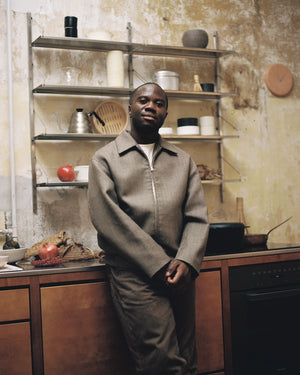
The Work in Process series is a look inside a design. From studio practice to iteration through sketch or material selection, the series brings to light the path from idea to reality. In its second installment, discover the practice behind Rivet—an entirely new technique developed by designer Jonas Trampedach in 2011 that led to a robust series within the FRAMA universe.
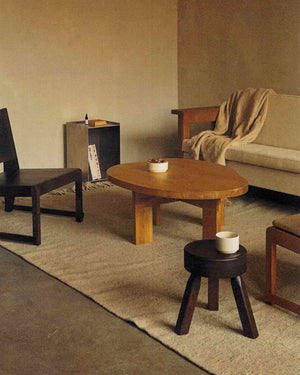
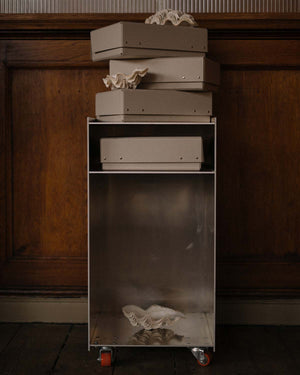
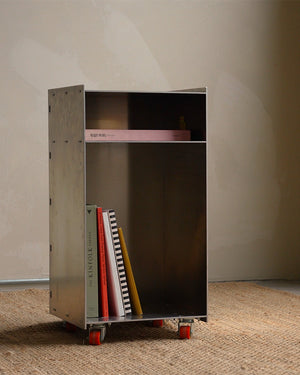
Created by designer Jonas Trampedach in 2011, the technique used to create the Rivet Series is a hand-hammered alternative to welding aluminum. This technique contributed to a defined and legible vocabulary that has led to an expanded collection—including the Glass Rivet Box Table as its second material iteration, with a different process of assembly inspired by its precursors in the series.


Ten years in, the Rivet remains one of FRAMA's most quietly radical designs. Rooted in industrial materiality and reduced to its essential geometry, the Rivet has come to symbolize FRAMA's belief that functional objects can carry lasting meaning. The Rivet Box Table is now often imitated, but the technique itself exists only in the FRAMA edition designed by Trampedach.
The origin story of Rivet begins during Trampedach’s time at the Denmark Science School from 2001-2004—where he became acquainted with metal working in part due to the popularity of the woodshop. As he describes it, the woodshop was always full and the metalshop was always empty, and through taking this space he learned the ways of working with metal.


“With wood, you have one go—metal is much more forgiving.”

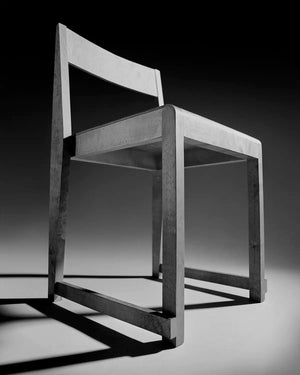
After graduating and beginning his practice, the designer embarked on a "statens kunstnerophold": a government-funded residency with access again to different workshops to experiment within. Trampedach had planned to design and fabricate a chair during his stay at the residency in 2011.
“I was operating under the default setting of a designer, which is to try and make a chair. I had planned to weld it and it went terribly wrong—which made me come up with another way of producing this design. I created a cold process: totally mechanical, joining the distinct pieces of the design perpendicularly.” Hand-hammered and extremely loud, the method is defined by Tampedach in a way that is visible in each piece in the Rivet Series—and missing from its many imitations that have emerged since its release. As Niels Strøyer Christophersen describes it: “it’s honest, straightforward—you see how it’s produced.” In keeping with FRAMA’s approach of design with minimal intervention, Rivet Series shows the hand of its designer and of its process.


By 2016, the Rivet Box Table, then Shelf, then Case were produced with FRAMA using that same technique. “In some ways I can see that this first chair wasn’t the most logical use of the new technique: it’s the form that led to its development, but the later pieces in the collection were a more natural evolution of the process.”
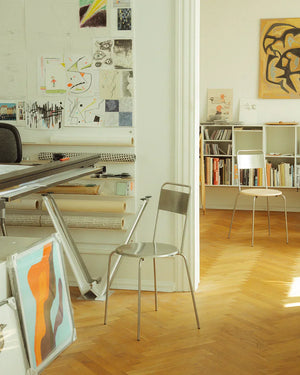
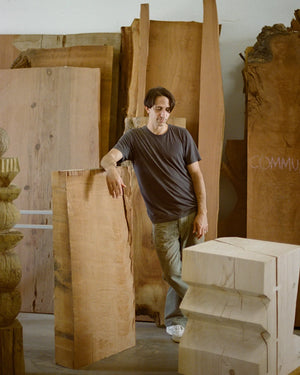
Over the ten years since Rivet was introduced, Trampedach describes that the workshop has become more of a starting point for other projects as well: it’s now less about card or computer models, but rather what happens when he stands with a material. “It gave me a bit of trust that it does make sense to spend time in the workshop and make mistakes; to see what can and can’t be done.”
As for the part of the process that determined the very-recognizable Rivet Box Cart dimensions? In addition to design, Trampedach is a great appreciator of music, with an impressive vinyl record collection. Looking for a standard size to base this new work on, he grabbed something uniform; that would always have the same dimensions. A record was nearby in the studio and provided the ideal new standard: just another essential step of many in the designer’s process.